


Facts on Animal Rights and veg*n issues: Factory Farming: Poultry
Knowing is better than believing!

Do animals thus know each other among themselves? They certainly do... Every poultry farmer knows that... there exists a very definite order, in which each bird is afraid of those that are above her in rank. After some few disputes, which need not necessarily come to blows, each bird knows which of the others she has to fear and which must show respect to her. Not only physical strength, but also personal courage, energy, and even the self-assurance of every individual bird are decisive in the maintenance of the pecking order. Konrad Lorenz, King Solomon's Ring

The chicken industry history Up

  • 1923: First broiler chicken raised in Delaware
  • 1940: Sulfa drugs and antributes
  • 1967: 40% of commercial layers are caged
  • 1978: 90% of commercial layers are caged

...between the horn and the bone is a thin layer of highly sensitive soft tissue, resembling the "quick" of the human nail. The hot knife used in de-beaking cuts through this complex of horn, bone and sensitive tissue, causing severe pain. Prof. FW Rogers Brambell - the Brambell Report

Broiler Chickens Up

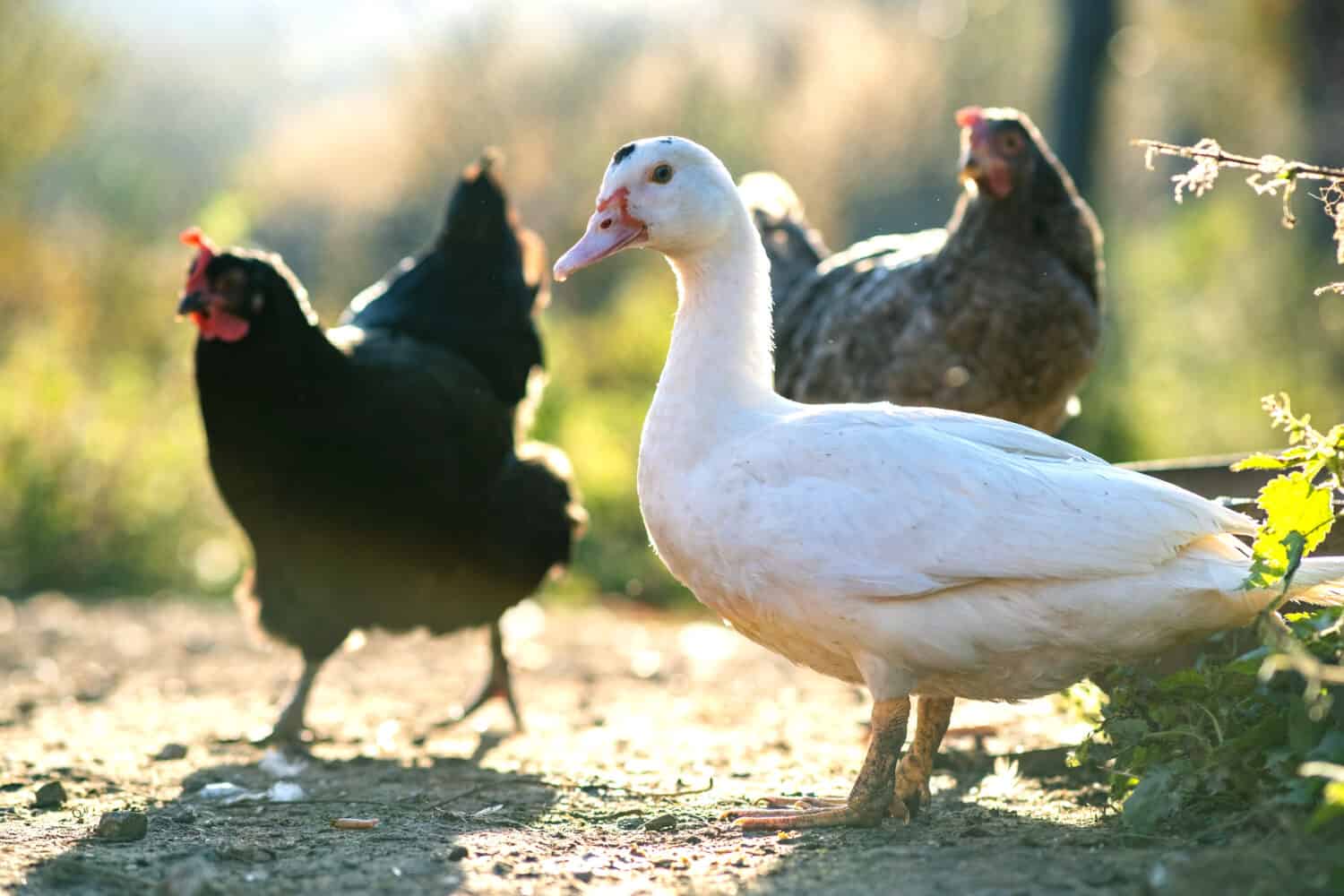
The first broiler chickens where raised in 1923 in Delaware. Thanks to the discovery of vit. A and D sunlight and exercise weren't needed for adequate growth and bone development of the birds. But largescale production added a new problem, disease and cannibalism. By burning off the tips of birds' beaks the loses from pecking and cannibalism where reduced. In the late 1940s Sulfa drugs and antibiotics where added in the chickens food. The time between coming out of the egg and going to the slaughterhouse is less than 12 weeks.

First, it must be noted that the degree of confinement to which the battery hen is subjected is extremely close and imposes strict limitation of the normal behavior pattern of the bird. Cages containing two or three birds and measuring 12-14 inches wide and 17 inches deep are commonly used. Under such conditions the birds cannot stretch their wings, move without touching one another or stand fully upright at the rear of the cage...
Much of the ingrained behavior pattern is frustrated by caging. The normal reproductive pattern of mating, hatching and rearing young is prevented and the only reproductive urge permitted is laying. They cannot fly, scratch, perch or walk freely. Preening is difficult and dust-bathing impossible.
The Brambell Report - pars. 57-58

Laying Hens Up

As egg laying hens produce tons of manure each week and are kept inside for more than a year (18-20 months) new ways of confiment where created as the wire-mesh cages. More hens die (because of higher crowding) but the higher production of eggs (chickens are less expensive than space) outweight the disadventages. In nature chickens can live as long as fifteen to twenty years but in the modern egg factory hens only have a lifespan of around a year and a half. After this their ability to lay eggs is so low that it becomes unprofitable to house and feed them, so they are made into soup and other processed foods. To keep egg-laying production economic hens undergow a process called forced molting (food is withheld for up to 14 days so the egg-laying cycle begins again).

Eggs and Chicks Up

Female chicks are sold to egg producers to begin their careers as 'layers'. The beaks are clipped (sometimes the toes as well) and they get vaccinated against a variety of poultry diseases. After twenty weeks in 'grow-out' buildings the hens are ready for the next stage (laying eggs). As male chicks are worthless (for egg-type hatcheries) they are collected when hatched and are put in plastic bags where they slowly suffocated to dead (as any other way of killing them takes to much work and by this costs to much). These dead bodies are sold to mink farms as feed for the minks. As the public is getting aware of this type of mass destruction, the hatchery industry is searching for new ways of killing as decapitation or by asphyxiation in a carbon dioxide chamber or by exploding the chicks in a decompression chamber. Many hatcheries simply grind up the live, newly hatched chicks and their shells into a meal, which is dehydrated and used as a protein supplement in the feeds of other factory animals. More or less half of the chicks are killed when born because of this.

FAQs and numbers Up

  • Every day, around 23 million chickens are killed in the U.S. (that's 269 deaths per second).
  • Out of 10 billion land animals killed (US), 9 billion are chickens.
  • In 1987 around 214 million chicks were destroyed as soon as they crawled out of their shells and revealed their sex.
  • Chickens are are a source of many foodborne pathogens including Campylobacter and Salmonella. 20% of broiler chickens in the US are contaminated with Salmonella and 80% are contaminated with Campylobacter in the processing plant.
  • In 1940, an hen produced around 134 eggs a year. Thanks to genetic and environmental manipulations this number has doubled.
  • About 95% of the more or less 300 million laying hens in the United States are confined in barren, wire "battery cages".
  • According to the National Animal Health Monitoring System, in 1999 around 83% of egg producers in 1999 used force molting. Feed withdrawel is banned in Europe.
  • In the United States more than 70% of the antibiotics is used by intensive farming

Stop animal cruelty. Go Vegan.
  • About ARC
  • Tell A Friend
Book cover - The case for Animal Rights by Tom Regan - from Amazone.

Find more about 'The case for Animal Rights' at Book Review

Join your local Animal Rights Group

The MEATRIX, a flash movie about the problems with modern factory farming.
An action thriller that will reveal the true nature of irresponsible factory farm mega-corporations. The illusion is about to end. Created by Free Range Graphics www.freerangegraphics.com

Vegan Starter Pack: Guide to Cruelty-Free Eating

Stop the exploitation and Go Vegan!

Want to write a fact? Comments/suggestions about this page you can leave at the forum.